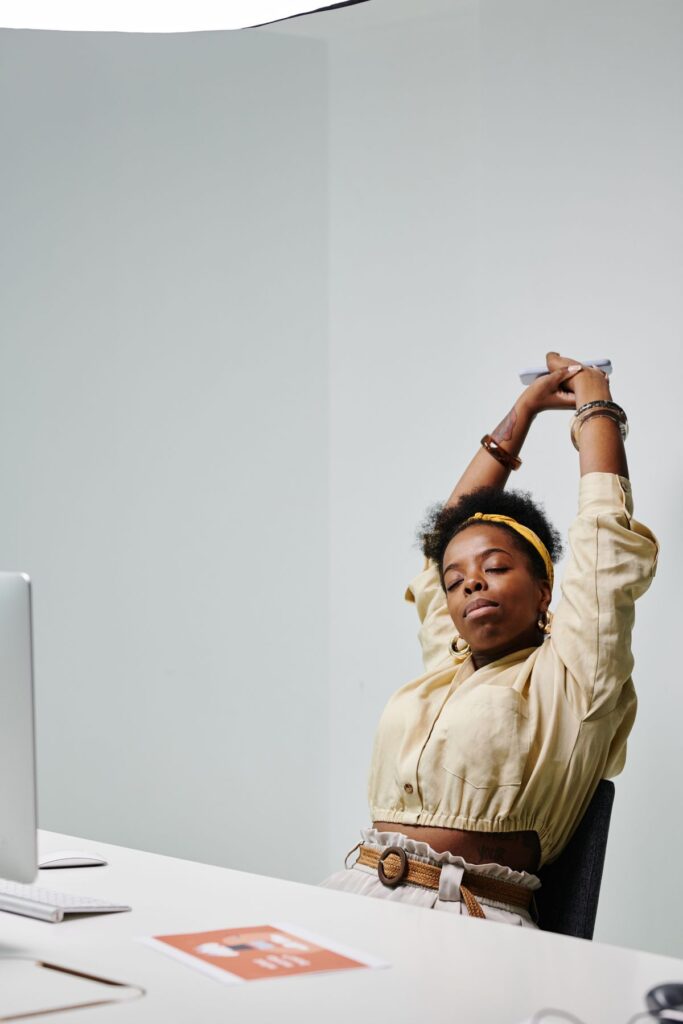
After a long day at a desk, many people notice the same pattern: the shoulders feel heavy, the upper back feels tight, and turning the neck becomes less comfortable. It is tempting to blame one “bad posture,” but desk-related tension is usually more about time, repetition, stress, and lack of movement than one exact sitting angle.
The good news is that you rarely need a complicated corrective routine. Short movement breaks, a more comfortable setup, gentle strength work, and better recovery habits can make a meaningful difference. This guide focuses on practical strategies for common, uncomplicated neck and shoulder tension.
Why desk work creates neck and shoulder tension
When you work at a screen, the muscles around the neck and shoulder blades hold the head and arms in relatively fixed positions. Even a comfortable posture can become tiring after an hour. Add concentrated work, deadline stress, phone use, and shallow breathing, and the muscles can feel increasingly tight.
That does not necessarily mean the muscles are “short” or damaged. Often they are simply fatigued and sensitive.
1. Stop trying to hold perfect posture all day
There is no single posture you should hold from morning to evening. Sitting upright can be comfortable for a while, then leaning back may feel better. Sometimes standing is useful. Sometimes moving is best.
Instead of asking, “Am I sitting perfectly?” ask, “How long have I been in this position?” Movement variety is often more useful than posture policing.
2. Take micro-breaks before you feel stiff
Waiting until the neck already hurts makes the break less useful. Set a loose cue to move every 30 to 60 minutes. Stand, roll the shoulders, walk to another room, refill water, or look away from the screen.
Even one or two minutes can interrupt a long static period. You do not need to stop work for 15 minutes every hour.
3. Bring the screen to you
If the screen is very low or far away, you may spend hours leaning forward simply to see it. Raise a laptop on a stand or books and use an external keyboard if possible. Center the main monitor so you are not constantly rotated to one side.
The aim is not to create a rigid ergonomic diagram. It is to make the work position easy and comfortable enough that you do not have to fight it.
4. Support your arms
When the arms have no support, the shoulder muscles work continuously to hold them in position. Chair armrests, a desk surface, or a supported forearm position can reduce that load.
Make sure the shoulders are not being pushed upward by armrests that are too high.
5. Relax the jaw and hands
Stress often appears in places we do not notice. You may clench the teeth, grip the mouse tightly, or keep the fingers tense while concentrating. Several times a day, check whether the jaw can soften and whether the hands can hold the keyboard or mouse more lightly.
6. Try a two-minute movement reset
When tension starts building, try this sequence:
- stand and walk for 30 seconds
- perform five slow shoulder rolls
- turn the head gently left and right five times
- reach the arms overhead if comfortable
- take three slow breaths with a longer exhale
The point is not stretching as far as possible. It is to give the body a different movement experience.
7. Add upper-back movement
The neck often works harder when the upper back stays still all day. Gentle thoracic rotation and extension can distribute movement more comfortably. Sit tall, place your hands across your chest, and rotate slowly from side to side. You can also lean the upper back gently over the top of a supportive chair if that feels comfortable.
8. Strengthen rather than only stretch
If you repeatedly stretch the same areas but the tension returns, consider strength and endurance. Rows, band pull-aparts, carries, presses, and other basic upper-body exercises can improve the capacity of the shoulders and upper back.
Start with light resistance and controlled movement. You do not need to train through sharp pain.
9. Do not forget the rest of the body
Neck and shoulder comfort is influenced by your total activity level. If you sit at work and then sit for the entire evening, one five-minute neck routine has to compete with many hours of inactivity.
Walking, general strength training, and normal physical activity can improve overall tolerance and recovery.
10. Use breathing to reduce unnecessary tension
When stressed, people often breathe higher into the chest and keep the shoulders slightly elevated. Try a few slower breaths without forcing them. Let the abdomen and lower ribs expand comfortably and make the exhale slightly longer.
Breathing is not a cure for mechanical pain, but it can be useful when tension and stress are clearly linked.
11. Check your vision
If you squint or lean toward the screen because text is difficult to read, your neck may be reacting to a visual problem rather than an ergonomic one. Increase text size and consider an eye examination if you are struggling to see clearly.
12. Use heat when it feels good
A warm shower or heat pack can make tight muscles feel more comfortable. Keep the temperature safe and protect the skin. Heat is a comfort strategy, not a requirement.
13. Can massage help desk-related tension?
Massage can help many people relax and may reduce the feeling of muscle tightness temporarily. It can be especially useful after travel, long desk days, or stressful periods. The best results usually come when hands-on care is combined with the habits that prevent the tension from immediately returning—movement, strength, sleep, and a workable desk setup.
14. What about foam rolling or massage balls?
A ball against a wall or gentle foam rolling can provide pressure to the upper back and shoulder muscles. Avoid pressing directly on the front or side of the neck or aggressively compressing sensitive areas. More pressure is not automatically better.
15. Build an end-of-work transition
If you work from home, the body may never get a clear signal that desk time has ended. Create one. Close the laptop, change clothes, take a 10-minute walk, shower, or do a short strength routine. This can reduce both physical and mental carryover from the workday.
A simple desk-day routine
Try this schedule for one week:
- Morning: five-minute walk or mobility session before work.
- Each hour: stand or move for one to three minutes.
- Lunch: take a 10-minute walk if possible.
- Afternoon: repeat the two-minute movement reset.
- After work: 15 to 30 minutes of walking, strength, or another activity you enjoy.
The consistency is more important than choosing perfect exercises.
When is neck or shoulder tension more than routine desk stiffness?
Get medical advice if symptoms persist for weeks, repeatedly worsen, or include numbness, tingling, weakness, severe headaches, dizziness, or pain traveling down the arm. Seek urgent care after significant trauma or if neck pain is accompanied by major neurological symptoms, fever with severe headache, chest pain, or other serious symptoms.
The bottom line
Neck and shoulder tension after sitting all day is usually not solved by one perfect posture. Move more often, make the workstation comfortable, support the arms, build upper-body strength, and use relaxation or massage as supportive tools rather than the only solution. If symptoms are persistent or neurological, get professional assessment.
Sources and further reading
This article is general wellness education and does not replace individual medical advice.